
Co-Living Property Investment in Australia
Co-living is a residential property model that combines private resident spaces with shared facilities. Like any property type, its suitability depends on the individual property, local housing demand, planning requirements, management and broader location fundamentals.
What Is Co-Living Property?
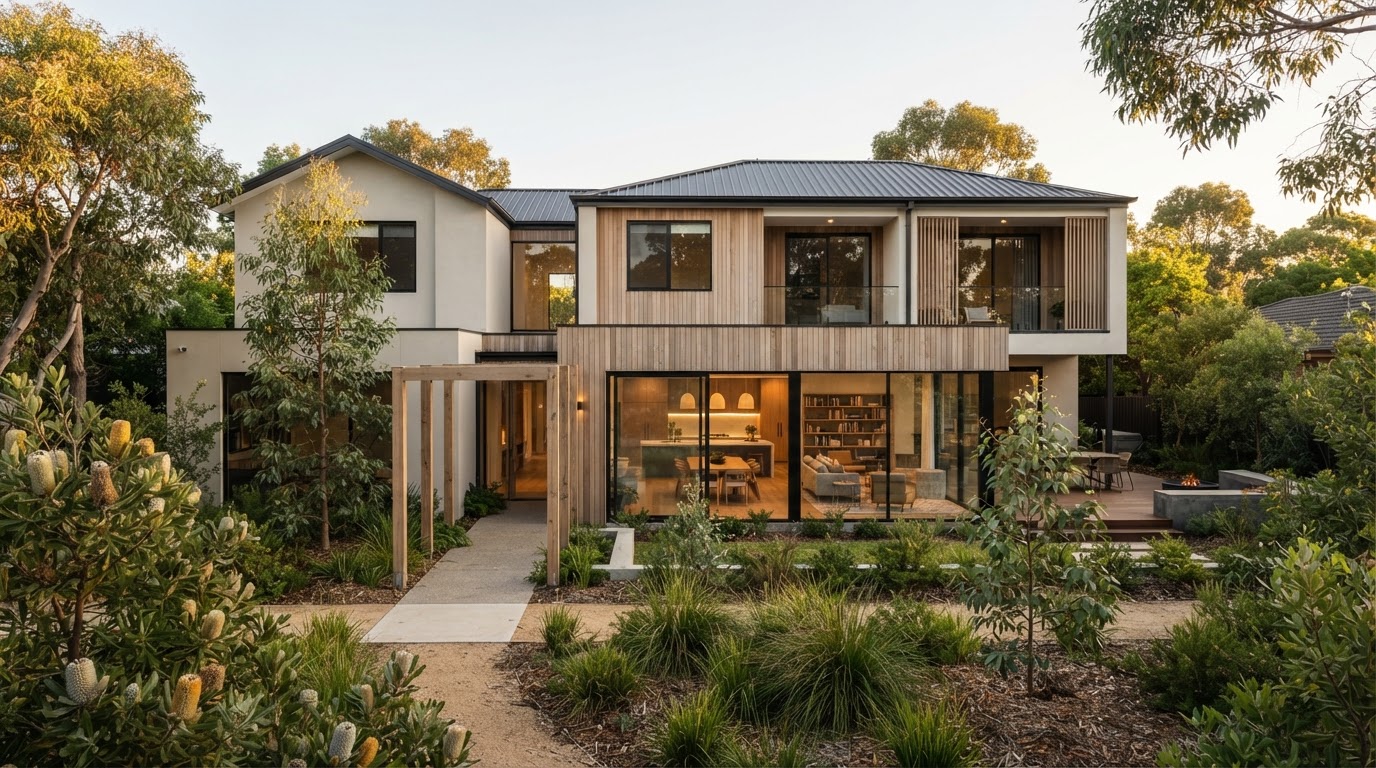
Co-living commonly describes residential accommodation where residents may have their own private sleeping or living areas while sharing some communal facilities. A co-living property may accommodate multiple residents, each with access to private spaces, alongside shared areas used in common.
Possible private spaces may include bedrooms, private bathrooms depending on the design, and storage. Possible shared spaces may include a kitchen, lounge, dining area, laundry, outdoor areas and parking. Not every co-living property has the same configuration, and the balance between private and shared space can differ substantially between designs.
The term "co-living" does not have one universal legal definition throughout Australia. Terminology, planning classification, occupancy rules and building requirements may vary between states, territories, councils, property configurations and building classifications. For a deeper explanation of the configuration, see how the co-living property model works in more detail.
This information is general and does not constitute legal or planning advice. The classification and approved use of an individual property should be confirmed with appropriately qualified professionals.
How Co-Living Differs From a Conventional Rental Property
A conventional residential rental is commonly occupied as one dwelling by one household. A co-living property may involve multiple private resident areas, communal facilities, different occupancy arrangements and more active management of shared spaces. However, not every co-living property rents rooms independently, and the legal arrangements depend on the property and jurisdiction.
| Factor | Co-Living Property | Conventional Rental Property |
|---|---|---|
| Resident configuration | May accommodate multiple residents within one property | Typically one household occupying one dwelling |
| Private areas | Bedrooms, and sometimes private bathrooms or storage | The dwelling is generally private to one household |
| Shared areas | Kitchen, living, dining, laundry, outdoor or parking may be shared | Generally no shared areas with other households |
| Occupancy | Occupancy arrangements can vary and may involve multiple agreements | Usually a single tenancy agreement for the dwelling |
| Property management | May involve more active management of shared spaces and residents | Typically managed as a single tenancy |
| Utilities | Metering and billing arrangements can vary between properties | Usually metered for the single dwelling |
| Maintenance | Shared facilities and multiple residents may affect maintenance needs | Maintenance for a single dwelling and one household |
| Privacy | Privacy depends on design, layout and acoustic separation | Generally higher privacy as a self-contained dwelling |
| Planning considerations | Use, classification and occupancy may require specific approvals | Standard residential use is typically straightforward |
This comparison is educational only. Neither property type is presented as better, and outcomes depend on the individual property, location and circumstances.
Why Property Design Matters
Property configuration can have an important influence on resident experience and property management. The way private and shared spaces are arranged may affect how the property functions in practice, how residents interact with it, and how it is maintained.
Design factors that may be relevant include bedroom configuration and size, bathroom arrangements, storage, communal area layout, kitchen capacity, laundry, parking, outdoor areas, access, privacy, acoustic separation and security.
No single design guarantees stronger rental demand. A well-designed co-living property may function quite differently from a poorly designed one, even where both carry the same label.
Private Space and Shared Space
The balance between private and communal space is central to how a co-living property operates. Residents may value different levels of independence, privacy, shared interaction, storage and access to facilities. The relevance of a particular design depends on local resident needs, the property configuration, the location and any applicable occupancy requirements.
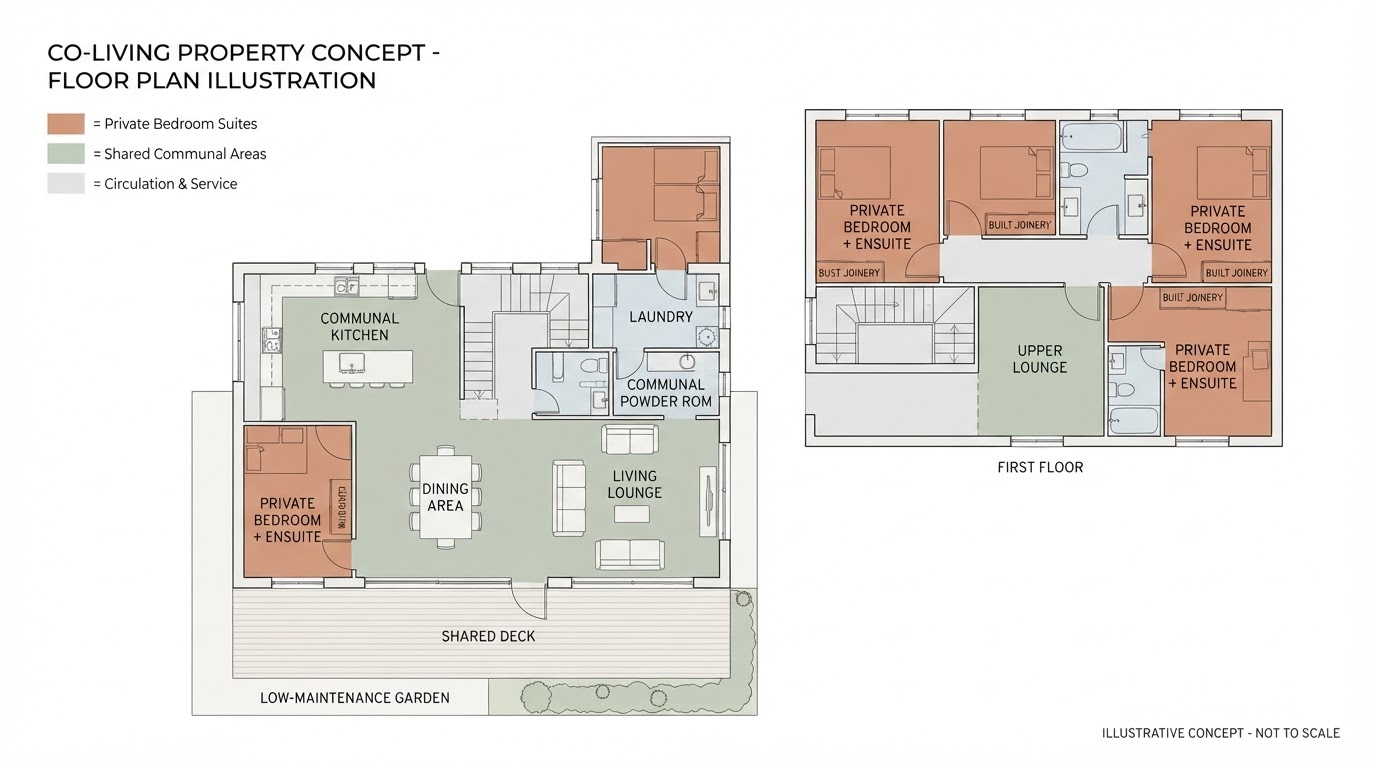
Illustrative co-living configuration concept only — not a real property or floorplan.
Local Demand Needs to Support the Property Model
More bedrooms or more resident areas do not automatically mean more rental demand. A co-living configuration only makes sense where local households are likely to seek that type of accommodation. Researching who may actually use the property locally is essential before assuming the model will be in demand.
Factors that may be worth investigating include local household types, employment, transport, affordability, demographics, competing rental accommodation, conventional rental supply, resident preferences and location accessibility.
Location Still Matters
Co-living should not be assessed simply from the property configuration. The surrounding location influences who may seek the accommodation, the rent it may achieve and its longer-term appeal. Location research may consider employment, transport, infrastructure, housing supply, rental demand, demographics, services, accessibility, planning, competing accommodation and location-specific risks.
Employment, Transport and Accessibility
Potential residents may consider access to employment, public transport, services, education, retail and community facilities. Convenient access to workplaces and transport can be relevant to whether the accommodation is sought after locally.
However, proximity to employment does not automatically create co-living demand. Local household needs, competing accommodation and affordability all play a part.
Property Management Considerations
Managing a property occupied by multiple residents may involve different operational considerations from a conventional single-household rental. Potential areas include resident turnover, maintenance, common-area upkeep, cleaning arrangements, property access, communication, utilities and shared facilities.
This does not mean co-living is automatically harder or easier to manage. Complexity depends on the model, the number of residents and the design. This page does not provide tenancy-management advice.
Utilities and Common Facilities
Utilities may require additional investigation in a co-living property. Potential services include electricity, water, internet, gas where applicable, shared appliances and communal services. The way utilities are metered, allocated and paid can differ between individual properties.
It should not be assumed that utilities are separately metered, that they are included in rent, or that one particular billing system applies. The arrangements for a specific property should be confirmed with the relevant providers and, where necessary, appropriately qualified professionals.
Furnishing and Maintenance
Some co-living arrangements may include furniture, common-area appliances or shared facilities. These can create practical considerations involving maintenance, replacement, wear and tear, cleaning and storage.
Not every co-living property must be furnished. Furnishing decisions should be made with reference to the intended occupancy model and any applicable requirements.
Planning, Building and Approvals
The intended use of a property may involve local planning requirements, building requirements, occupancy requirements, applicable approvals, building classification and local council rules. These can vary significantly between properties and jurisdictions.
The term "co-living" does not itself determine what use is legally permitted. The individual property and intended occupancy arrangement need to be checked against applicable requirements. This page does not provide legal or planning advice, and an ordinary house should not be assumed to be convertible into co-living accommodation without proper investigation.
Planning, building and occupancy requirements should be confirmed with appropriately qualified professionals for any specific property.
Fire and Safety Requirements
Multiple-occupancy properties may require investigation of matters involving building classification, smoke alarms, fire separation, exits, access, occupancy and emergency requirements, depending on the property and jurisdiction.
This page does not provide technical building specifications or DIY instructions. Appropriately qualified building, planning and safety professionals should be consulted for the individual property.
Finance and Valuation Considerations
Lenders and valuers may consider property type, configuration, approved use, title, location, borrower circumstances and lender policy when assessing a co-living property. The way a property is classified can affect how readily it is financed or valued.
This page does not recommend lenders, predict valuations, predict borrowing capacity, provide loan advice, or state that co-living finance is universally easier or harder. Borrowing arrangements should be discussed with an appropriately qualified lending professional.
Insurance Considerations
Insurance requirements may depend on occupancy, property configuration, use, common areas and property characteristics. A multi-resident property may have different insurance considerations from a conventional single-household rental.
This page does not recommend insurance products, provide premium estimates or give insurance advice. The individual property and intended use should be disclosed accurately to an appropriately qualified insurer or professional.
Rental Yield and Co-Living
Multiple resident areas do not automatically mean higher yield, better cash flow or stronger financial performance. Gross rental income is not the same as net rental income, cash flow or investment return.
Potential expenses may differ depending on management, utilities, maintenance, furnishing, vacancy and property configuration.
Potential Characteristics of Co-Living Property
The following are potential characteristics or considerations of the model. They should not be translated automatically into financial advantages.
Accommodation for multiple residents
A co-living property may provide private living areas for more than one resident within a single property.
Private and shared living spaces
The model combines private resident areas with shared communal facilities, though the balance varies by property.
Flexible residential configuration
Different designs may suit different household or resident needs, depending on the layout and location.
Different household needs
The configuration may appeal to residents seeking smaller private accommodation with access to shared facilities.
Shared facilities
Communal areas such as kitchens, living spaces or laundry may be shared, which can affect how the property operates.
Whether any potential characteristic is realised depends on the individual property, location, costs and circumstances.
Risks and Issues to Investigate
A balanced assessment should consider potential risks alongside any potential characteristics. The purpose is not to discourage investigation, but to show that co-living requires proper due diligence.
None of these issues means co-living property is inherently problematic, but each may require investigation before a decision is made.
Co-Living vs Dual-Key
Co-living commonly involves multiple private resident spaces together with some shared communal facilities. A dual-key property generally involves two more distinct living areas within an overall property configuration. Individual property designs vary, and the two should not be treated as interchangeable.
This page does not claim one produces better returns.
Co-Living vs Duplex
A duplex generally involves two residential dwellings within an overall development or building configuration. Co-living is a different housing concept and may involve multiple private resident areas and shared facilities. The two should not be conflated.
Does Co-Living Automatically Provide More Rental Income?
No. Potential rental income depends on actual rent achieved, occupancy, local demand, property configuration, expenses, management, utilities, maintenance and market conditions. Multiple resident areas do not guarantee higher income, and this page does not forecast any numbers.
Does Co-Living Automatically Mean Positive Cash Flow?
No. Cash flow depends on actual income, relevant expenses, vacancy, management, maintenance, finance costs where applicable and other circumstances.
Co-Living Property Research Checklist
A practical checklist may help structure further investigation. These questions are educational only and are not an investment score or a buy decision tool.
Property
- What is the exact property configuration?
- Which areas are private and which are shared?
- How much privacy exists between resident areas?
- How is parking arranged?
- How are common areas designed?
Legal / Planning
- What use has been approved for the property?
- What building classification applies?
- What occupancy requirements apply?
- Have applicable approvals been independently verified?
Location
- Who may require this type of accommodation locally?
- What employment exists nearby?
- What transport is available?
- What competing accommodation exists?
- What housing supply exists in the area?
Management
- How will common areas be managed?
- How will maintenance work?
- How are utilities handled?
- What resident-management responsibilities exist?
Financial / Professional
- What rent information is actual versus estimated?
- What operating expenses apply?
- How might lenders assess the property?
- What insurance arrangements are appropriate?
- Which matters require independent professional advice?
For a more detailed research framework covering configuration, approved use, building and safety, resident demand, management, utilities, finance and insurance, see Barry's guide on what to research before considering a co-living property.
Is Co-Living Property a Good Investment?
There is no universal answer. Co-living describes a residential property model, not an investment outcome. Whether an individual property warrants further investigation depends on the property itself, its approved use, location, local housing demand, supply, management, expenses, risks and the circumstances of the individual investor.
This page does not recommend co-living property and does not suggest it is automatically suitable or unsuitable.
Barry Ison's Approach to Co-Living Property
Barry does not assess a property simply because it is marketed as co-living, high yield, multiple income, high occupancy or strong cash flow. With more than 40 years of Australian property-industry experience, his research may consider the investor, the individual property, property configuration, location, housing supply, tenant or resident demand, employment, infrastructure, planning, management and risks.
Barry's approach starts with understanding the investor and then investigating the location and individual property rather than assuming a particular property type is automatically suitable.
How Does the Co-Living Model Actually Work?
If you want to understand the property configuration in more detail — including private and shared spaces, occupancy considerations, management, utilities and planning — read Barry's detailed guide to how the co-living property model works.
How the Co-Living Model WorksBarry explores the importance of understanding property types, local markets and underlying property fundamentals in The Diamonds of Australian Real Estate. The book provides broader education about Australian property markets, different property types, location research and the questions worth asking before buying.
Explore Property Investment with Barry
Co-living is one of several residential property types that may warrant investigation depending on the investor, property and location. Learn more about Barry's broader property-research approach.
Frequently Asked Questions
Common questions Australians search about co-living property investment.
General Information Disclaimer: This information is provided for general educational and informational purposes only. It does not take into account your personal objectives, financial position or needs and does not constitute financial, investment, taxation, legal, planning, building, tenancy, lending, insurance or property advice. Co-living terminology, property classifications, approvals, occupancy arrangements and regulatory requirements can vary between properties and jurisdictions. Property investment involves risk and market conditions can change. Consider obtaining independent advice from appropriately qualified professionals before making financial, legal, planning, taxation, lending or property decisions. Past performance is not indicative of future results.
