
What Is a Dual Key Property? Understanding the Configuration
"A dual key property generally describes a single residential building on one title that contains two separate, self-contained living areas. The configuration is different from a duplex, and a dual key label does not determine an investment outcome."
Executive Summary & Context
A dual key property generally describes a single residential building on one land title that contains two separate, self-contained living areas behind a shared roofline or shared entry structure. Each living area typically has its own kitchen, bathroom, living space and private access. This article explains what a dual key property is in an educational way. It does not recommend dual key properties, claim that they produce higher returns than other property types, or provide lending, taxation or financial advice. Individual properties vary, and whether a dual key property warrants investigation depends on the individual property, its location, approved use, local demand and the circumstances of the investor. For a broader look at how Barry researches property, see his Property Investment Services.
What Is a Dual Key Property?
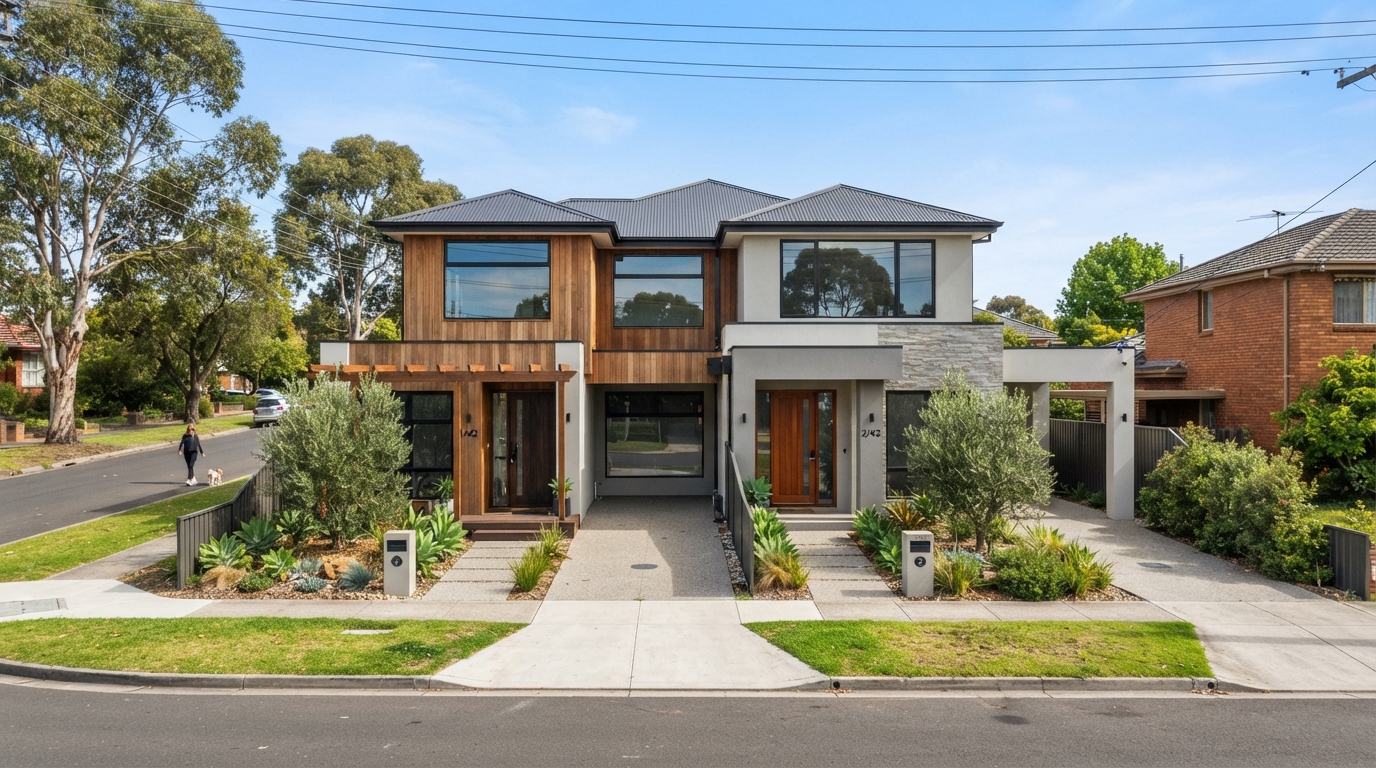
A dual key property generally refers to a residential building constructed on a single land title that contains two distinct, self-contained living areas. The two areas are typically integrated under one roofline and may share a common wall, entry structure or facade, but each has its own kitchen, bathroom, living area and private access door. The term 'dual key' is commonly used in the Australian property industry to describe this configuration, though individual properties and terminology can vary. This article does not provide a universal legal definition, because planning classifications and occupancy rules can differ between states, territories and councils.
How the Configuration Generally Works
In a typical dual key configuration, the main dwelling may contain three or four bedrooms, while the second living area may contain one or two bedrooms. Both areas are designed to function independently, with separate kitchens, bathrooms and living spaces. Because the property sits on a single title, it is generally treated as one property for council rates and land tax purposes, though individual circumstances and jurisdictions can vary. Whether the two living areas can be rented to separate tenants depends on the property's approved use, local planning requirements and applicable tenancy laws. This article does not assume that separate tenancy is always permitted, because that depends on the individual property and jurisdiction.
- Two self-contained living areas within a single building on one title.
- Each area typically has its own kitchen, bathroom, living space and private access.
- Generally treated as one property for council rates — though individual circumstances vary.
- Whether separate tenancy is permitted depends on approved use and local requirements.
Single Title Structure
A defining characteristic commonly associated with dual key properties is that both living areas exist on a single land title. This means the property is purchased as one asset and cannot generally be sold as two separate properties without undergoing a formal subdivision process, which may require council approval and may not always be possible depending on zoning, lot size and local planning rules. This is different from a duplex that has been strata-titled, where each side may be sold independently. The single-title structure may affect resale, finance and valuation, and these matters may warrant investigation for an individual property.
Dual Key vs Duplex
Dual key and duplex are sometimes confused, but they generally describe different configurations. A duplex typically involves two separate dwellings, which may be attached or detached, and may be on separate titles once subdivided. A dual key property typically involves two living areas within a single building on one title. The distinction can matter for finance, resale, planning and management. However, individual properties vary, and the terminology used in marketing does not always match the legal or planning classification. For a detailed comparison, see Barry's guide to dual key versus duplex. Neither configuration is universally better, and this article does not claim that one produces stronger returns than the other.
- Duplex: typically two separate dwellings, potentially on separate titles.
- Dual key: typically two living areas within one building on a single title.
- The distinction can affect finance, resale, planning and management.
- Marketing terminology does not always match the legal classification — verify the individual property.
Dual Key vs Other Property Types
A dual key property is one of several residential property configurations available in Australia. Others include conventional houses, apartments, duplexes, house-and-land packages and co-living arrangements. Each has different characteristics. A dual key property is not automatically a better investment than a conventional house, an apartment or a duplex. The configuration is a property characteristic, not an investment outcome. Whether a dual key property warrants investigation depends on the individual property, its location, local demand for the type of accommodation it provides, approved use, expenses, risks and the investor's circumstances. For more on how different property types compare, see Barry's guide to duplex property investment.
Why Configuration Does Not Determine Returns
Having two living areas does not automatically mean higher rental income, better cash flow or stronger returns. Potential rental income depends on the actual rent achieved, occupancy, local demand, the property's configuration, expenses, management and market conditions. Gross rental income is not the same as net rental income or cash flow, because expenses reduce what the investor actually retains. A dual key property may have additional expenses related to managing two living areas, maintenance, utilities and furnishing. Whether the configuration supports the investor's objectives depends on the individual property and circumstances, not on the label alone. For a clearer explanation of gross and net rental yield, see Barry's guide to how rental yield is calculated.
- Two living areas do not automatically mean higher rental income or better cash flow.
- Gross rental income is not the same as net income or cash flow.
- Additional expenses may apply to managing two living areas.
- Suitability depends on the individual property and investor, not the configuration label.
Risks and Considerations
Dual key properties may involve considerations that differ from a conventional single-dwelling rental. These can include planning and approved use requirements, building classification, fire and safety requirements for multiple-occupancy configurations, utility metering arrangements, managing two separate tenancies, maintenance of shared structures, resale market depth (the buyer pool for dual key properties may differ from conventional houses), and how lenders and valuers assess the property. This article does not list every possible risk, and the relevance of each depends on the individual property and jurisdiction. The purpose is to show that a dual key property requires proper due diligence, not to suggest it is inherently better or worse than other property types.
- Planning, approved use and building classification may need verification.
- Fire and safety requirements may differ for multiple-occupancy configurations.
- Utility metering and billing arrangements can vary.
- Managing two tenancies may involve different operational considerations.
- Resale buyer pool and lender assessment may differ from conventional houses.
Questions to Investigate
For someone researching a dual key property, questions worth considering may include: What is the exact configuration of the two living areas? What use has been approved for the property? Can the two areas be rented separately under local requirements? How are utilities metered and billed? What expenses apply to managing two living areas? How might lenders and valuers assess the property? What is the local demand for this type of accommodation? These questions are educational prompts, not a guarantee of a good decision. They reflect the principle that the individual property and location need to be investigated rather than assumed.
- What is the exact configuration and what use has been approved?
- Can the two areas be rented separately under local requirements?
- How are utilities metered and billed?
- What expenses apply, and how might lenders assess the property?
- What is the local demand for this type of accommodation?
Frequently Asked Questions
Common questions Australian investors ask regarding property investment strategy and market entry.
- A dual key property generally describes two self-contained living areas within one building on a single title.
- Dual key and duplex are different configurations with different title, planning and resale implications.
- Having two living areas does not automatically mean higher rental income or better cash flow.
- Planning, approved use, building classification and utility arrangements may need verification.
- A dual key label does not determine an investment outcome — the individual property and location matter.
- Whether a dual key property warrants investigation depends on the investor's circumstances and proper due diligence.
Summary & Strategic Outlook
Understanding what a dual key property is provides a foundation for further research, not a conclusion. A dual key property describes a residential configuration — two living areas within a single building on one title — not an investment outcome. Whether an individual dual key property warrants investigation depends on the property itself, its approved use, location, local demand, expenses, risks and the circumstances of the investor. This article is general education only and does not constitute financial, investment, taxation, legal, planning, lending or property advice. For a broader look at how Barry researches property within the context of the individual investor, explore his Property Investment Services.

Barry Ison
Property Investment Advisor with over 40 years of hands-on experience guiding Australian investors through property acquisition, growth corridor analysis, negative gearing strategy, and long-term portfolio structuring.
Related Market Insights
What Is Property Investing? An Educational Introduction
A clear educational introduction to what property investing means in Australia — covering how it works, capital growth versus rental income, different property types, location and risk considerations, and why a property label does not determine an investment outcome.
7 Things to Compare Before Choosing Between Dual-Key and Duplex Property
A practical comparison of the seven factors worth researching when comparing dual-key and duplex investment property in Australia — configuration, title, privacy, demand, management, location and resale.
What Is a Property Investment Advisor and What Do They Do?
A plain-English explanation of what a property investment advisor does, how property research works, and how the role differs from financial, legal, tax and lending professionals.
Book Your Personal Strategy Session
Speak directly with Barry Ison (40+ years experience) to discuss your financial targets and build a customized property portfolio strategy.
