
Capital Growth vs Rental Yield: Understanding the Difference
"Capital growth and rental yield describe two different aspects of property performance. Neither measure, on its own, determines whether a property is suitable — and neither is guaranteed."
Executive Summary & Context
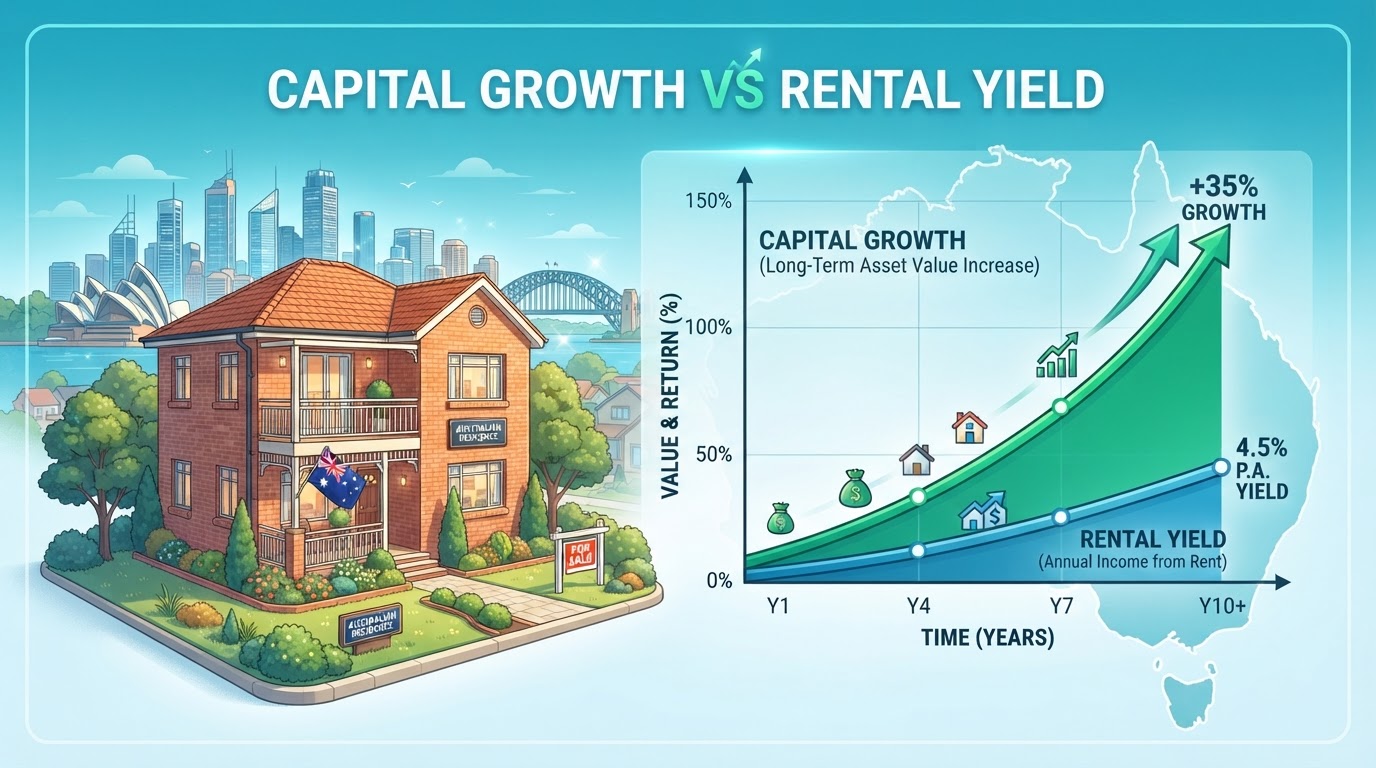
Capital growth and rental yield describe two different aspects of property performance. Capital growth refers to how a property's value has changed over time, while rental yield expresses rental income relative to the property's value or purchase price. Neither measure, on its own, determines whether a property is suitable. Capital growth is not guaranteed, rental income is not guaranteed, rental yields can change, and property values can rise or fall. Individual costs and circumstances always matter. This article explains the difference between capital growth and rental yield in general educational terms so readers can understand what each metric does and does not tell them about an individual property.
What Is Capital Growth?
Capital growth describes an increase in a property's value over a period of time. It is a measure of how the market value of a property has changed between two points in time. Importantly, property values can increase, remain relatively unchanged, or decline. Capital growth is not inevitable, and a property that has grown in value over one period may not continue to do so. Historical capital growth can be measured after it has occurred, but it does not prove what will happen next. Conceptually, historical capital growth is the change in property value over a historical period. This article does not provide a future-growth calculator, because future property values cannot be reliably predicted from past movements.
- Capital growth measures the change in a property's value over time
- Property values can increase, remain flat or decline
- Historical growth is measured after it has occurred
- Past growth does not guarantee future growth
What Is Rental Yield?
Rental yield expresses rental income relative to a property's value or purchase price. It is a way of describing how rental income compares to the value of the asset, rather than simply looking at the weekly or monthly rent in isolation. Rental yield is not guaranteed income. Rent can change, properties can sit vacant, and the expenses associated with holding a property can change over time. There are different ways to express rental yield, and the two most commonly discussed are gross rental yield and net rental yield.
What Is Gross Rental Yield?
Gross rental yield generally compares annual gross rent with the relevant property value or purchase price. For educational purposes only, a generic formula may be shown: annual gross rent divided by property value, multiplied by 100. This produces a percentage that describes gross rental income relative to property value. The key limitation is that gross yield does not account for many property expenses. A gross yield figure tells you something about income relative to value, but it does not tell you what the property actually costs to own or what the net position might be. This article does not provide a target yield, a 'good yield' threshold, or recommendations based on the result.
- Gross yield compares annual gross rent with property value
- Generic formula: (annual gross rent ÷ property value) × 100
- Does not account for property expenses
- A headline yield alone does not indicate suitability
What Is Net Rental Yield?
Net rental yield considers certain property-related expenses before comparing income with property value. Depending on the property, expenses may include property management, maintenance, insurance, council rates, strata or body corporate costs where relevant, periods without rental income, and other property-related expenses. The precise calculation can vary depending on which costs are included, so net yield figures are not always directly comparable between sources. This article does not provide tax advice, does not tell readers which expenses are tax deductible, and does not calculate anyone's personal net return. The purpose is simply to explain that net yield attempts to account for costs that gross yield ignores.
- Net yield factors in certain property expenses
- Costs may include management, maintenance, insurance, rates and strata
- Calculation varies depending on which costs are included
- Net and gross yield figures are not always directly comparable
Capital Growth vs Rental Yield: The Key Difference
The table below summarises how the two measures differ. Neither is ranked, and there is no 'which is better' row, because they measure different things and their relevance depends on the individual property and circumstances.
- What it measures: Capital growth — change in property value over time; Rental yield — rental income relative to property value
- How it is expressed: Capital growth — as a change in value or percentage change; Rental yield — as a percentage
- Relates to: Capital growth — property value; Rental yield — rental income
- Expenses directly affect the measure: Capital growth — no; Rental yield — net yield yes, gross yield no
- Can change over time: Both can change
- Main limitation: Capital growth — historical, not predictive; Rental yield — one measure, ignores many factors
Does a High Rental Yield Mean a Better Property?
Not necessarily. Rental yield is one measure only. A higher headline yield does not automatically indicate that an individual property is suitable, and it does not imply high-yield property is bad either. Other factors may include property price, expenses, vacancy, tenant demand, property condition, maintenance, location, housing supply, property type, ownership structure and risks. A high advertised yield can reflect a range of underlying circumstances, some of which may warrant further investigation rather than immediate enthusiasm. Yield should be considered alongside the broader characteristics of the property and location, not in isolation.
Does Strong Historical Capital Growth Mean It Will Continue?
No. Historical performance describes what has already occurred. Future property values can be influenced by changing supply, demand, employment, population, economic conditions, infrastructure, credit conditions and property-specific factors, none of which can be reliably predicted. A suburb or property that performed strongly over a past period may not repeat that performance. Past performance is not indicative of future results, and historical growth should never be presented as though it will continue.
Can a Property Have Both Capital Growth and Rental Income?
Conceptually, a property can produce rental income while its market value changes over time. However, neither outcome is guaranteed. The amount of rent can change, occupancy can change, expenses can change, and property values can rise or fall. This article does not imply that investors can reliably find properties offering both high growth and high yield. The relationship between income and value varies between properties, markets and time periods, and there is no universal rule that ties the two together.
Why Location Matters
Both rental conditions and property values can be influenced by local property-market characteristics. Employment, housing supply, tenant demographics, infrastructure, accessibility, population, local services, property type and surrounding development can all form part of the picture. None of these factors guarantees capital growth or rental performance. For broader context on how locations can be researched, see Barry's Property Investment Locations guide, as well as the NSW Property Investment and Queensland Property Investment hubs. No state is being compared here on expected returns; the point is that individual markets should be researched on their own fundamentals.
Why Property Type Matters
Rental arrangements and buyer markets can differ between property types, including detached houses, apartments, duplexes, dual-key properties and house-and-land property. No property type is stated to produce better returns. For deeper reading on specific configurations, see the Duplex Property Investment Australia guide, the Dual Key vs Duplex comparison and the article on seven things to compare before choosing between dual-key and duplex property. Property configuration is only one consideration alongside location, expenses, risks and the investor's circumstances.
Why One Number Does Not Tell the Whole Story
An investor should not judge an individual property solely using historical capital growth, advertised rental yield, weekly rent, property price or vacancy rate. Numbers need context. A rental yield tells you something about rental income relative to property value. Historical capital growth tells you something about how value changed in the past. Neither tells you everything about the individual property, location, expenses or risks. Combining two numbers into a simple 'investment score' does not make a property suitable, because the underlying factors — employment, supply, demand, infrastructure, property condition, ownership structure and risks — still require separate investigation.
Capital Growth vs Cash Flow
These terms are also different. Capital growth concerns changes in property value. Cash flow concerns money moving into and out of owning the property. Cash flow may be influenced by rental income, property expenses, finance costs, vacancy and maintenance. This section is educational only. It does not calculate personal cash flow, provide borrowing advice, provide tax advice, recommend positive or negative gearing, or tell readers what cash-flow position they should target. Cash flow and capital growth describe different aspects of a property, and both can change over time.
Questions Worth Asking Beyond Growth and Yield
Rather than focusing only on a growth or yield figure, an investor may ask broader questions about the property and location. These questions are educational and are not personalised investment advice.
- What creates housing demand in this location?
- What competing housing supply exists?
- Who is likely to rent this type of property?
- What expenses may apply to this property?
- What risks affect the individual property?
- What is the ownership structure?
- What condition is the property in?
- Is the advertised rent supported by appropriate evidence?
- Is historical growth being presented as though it will continue?
- What information requires independent verification?
Historical Case Studies
Barry's website contains genuine historical case studies that may illustrate how capital growth is measured after it has occurred, or how rental configuration and income characteristics can form part of property research. These include the Denman NSW case study, the Cessnock NSW case study, the Western Australia Dual-Key case study and the South of Sydney Dual-Key case study. Only financial figures that have genuinely been supplied by Barry are referenced. This article does not invent rental yields, purchase prices, rent, valuations, expenses or capital-growth percentages, and it does not claim that any historical case study proves a particular strategy is better. Where historical performance data is used, figures relate to this individual historical case study. Property values and market conditions vary, and past performance is not indicative of future results.
How Barry Approaches Property Research
Barry does not assess an individual property solely on advertised rental yield, historical price growth or one market statistic. His research may consider the investor, the individual property, location, property type, housing supply, rental demand, employment, infrastructure, property characteristics and potential risks. Barry has more than 40 years of Australian property-industry experience. He does not claim to find high-growth properties, identify properties with superior yields, predict capital growth or maximise investor returns. To understand how Barry researches individual property opportunities beyond headline growth and yield figures, explore his Property Investment Services page.
Going Deeper: The Diamonds of Australian Real Estate
Barry explores the importance of looking beyond individual property statistics in The Diamonds of Australian Real Estate, drawing on more than 40 years of property experience. The book discusses Australian property markets, market drivers, different property types, property research and the questions investors may investigate before buying. It is an educational resource, not a promise of investment returns, and reading or buying it will not improve investment performance on its own.
Frequently Asked Questions
Common questions Australian investors ask regarding property investment strategy and market entry.
- Capital growth measures change in property value over time; rental yield measures rental income relative to property value.
- Gross yield ignores expenses; net yield attempts to account for some of them, and the two are not always directly comparable.
- A high advertised rental yield does not automatically make a property suitable.
- Historical capital growth is measured after it occurs and does not predict future growth.
- Neither metric should be considered in isolation — location, property type, expenses, vacancy and risks all matter.
- Cash flow and capital growth are different concepts describing different aspects of a property.
- No formula combining yield and growth can reliably predict investment performance.
- Historical case-study figures relate to individual examples and are not indicative of future results.
Summary & Strategic Outlook
Capital growth and rental yield describe two different aspects of property performance, but neither metric alone determines whether a property is suitable. Capital growth is historical and not predictive, rental yield is one measure that ignores many costs and risks, and a high headline figure does not replace broader research into location, property type, expenses, vacancy and individual property characteristics. Barry Ison's approach is to examine the individual property and the fundamentals surrounding its location rather than relying on one statistic. To understand how Barry researches individual property opportunities beyond headline growth and yield figures, explore his Property Investment Services page.

Barry Ison
Property Investment Advisor with over 40 years of hands-on experience guiding Australian investors through property acquisition, growth corridor analysis, negative gearing strategy, and long-term portfolio structuring.
Related Market Insights
What Is Property Investing? An Educational Introduction
A clear educational introduction to what property investing means in Australia — covering how it works, capital growth versus rental income, different property types, location and risk considerations, and why a property label does not determine an investment outcome.
What Is a Dual Key Property? Understanding the Configuration
An educational guide to what a dual key property is in Australia — covering how the configuration works, the single title structure, how it differs from a duplex, potential characteristics, risks to investigate, and why the configuration does not determine investment returns.
7 Things to Compare Before Choosing Between Dual-Key and Duplex Property
A practical comparison of the seven factors worth researching when comparing dual-key and duplex investment property in Australia — configuration, title, privacy, demand, management, location and resale.
Book Your Personal Strategy Session
Speak directly with Barry Ison (40+ years experience) to discuss your financial targets and build a customized property portfolio strategy.
