
What Is Equity and How Does It Relate to Property Investment?
"Property equity is generally the difference between a property's current value and the amount owed against it. Equity is not the same as cash, and having equity does not automatically mean it can or should be borrowed against."
Executive Summary & Context
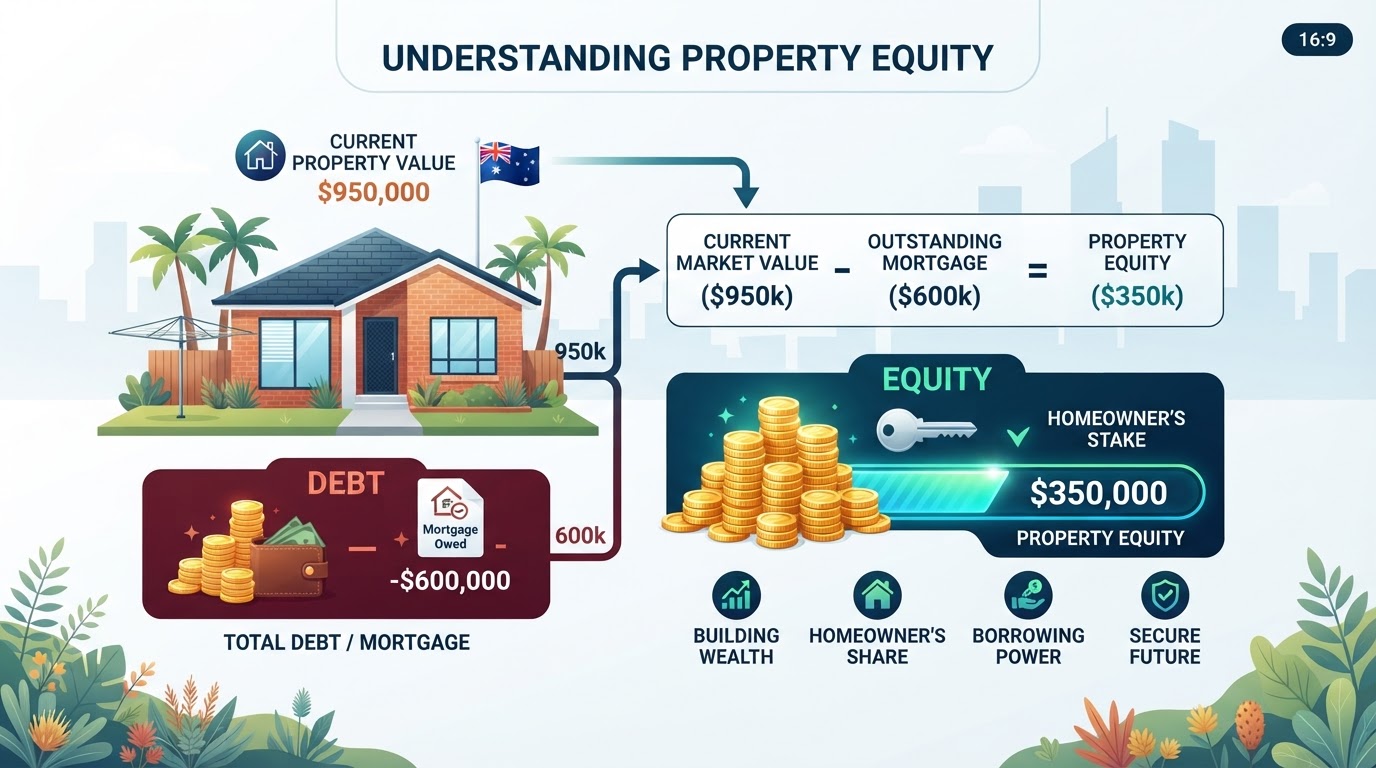
Property equity is generally the difference between a property's current value and the amount owed against it. For example, if the property value changes or the outstanding loan balance changes, the amount of equity can also change. Equity is not the same as cash, and having equity does not automatically mean it can or should be borrowed against. It is important to understand from the outset that property values can rise or fall, valuations can vary, loan balances change, usable equity may differ from total equity, borrowing capacity is separate, and accessing equity generally means taking on additional debt. This article explains what property equity is so you can better understand the figures you encounter when considering your financial position. For a broader look at how Barry researches individual properties, see his Property Investment Services.
What Is Property Equity?
At a basic conceptual level, property equity equals the current property value minus the amount owed against the property. Equity represents the difference between these two figures at a particular point in time. It is an ownership interest in the property, not a sum of money held in an account. Because both the property value and the loan balance can change, the amount of equity is not a permanently fixed figure.
A Simple Hypothetical Equity Example
To demonstrate the arithmetic, consider a hypothetical educational example only. Suppose a property has a value of $800,000 and the amount owed against it is $400,000. The calculated equity is $800,000 minus $400,000, which equals $400,000. This hypothetical example is provided only to demonstrate the calculation and does not represent Barry Ison's clients, a lending recommendation or current Australian property data. The resulting figure is not described here as good, bad, desirable, ideal or attractive — it exists only to demonstrate the concept.
Property Value Is Not the Same as Equity
Property value is an estimate of what the property may currently be worth. Equity is the difference between the value being used and the amount owed against the property. A property may have a substantial market value but relatively limited equity if the outstanding debt is also substantial. Conversely, a lower-value property with little debt may have proportionally higher equity. This section does not recommend a particular debt level — it simply explains that value and equity are different figures.
Equity Is Not the Same as Cash
Equity exists within the property. It is not automatically money that someone can withdraw, spend, invest or transfer. Accessing part of that equity usually requires an appropriate financial arrangement, which may involve additional borrowing. Additional borrowing increases debt and usually creates additional financial obligations. Equity should not be romanticised or promoted as free money, and it should not be described as wealth sitting idle waiting to be unlocked. It is an ownership interest, and converting any of it into accessible funds generally means taking on more debt.
What Is Usable Equity?
Usable equity is a term commonly used to describe a portion of property equity that might potentially be available for borrowing, subject to lender criteria and individual circumstances. This article does not create a universal usable-equity formula and does not state that any particular percentage of a property's value can be accessed. Lender policies can differ and change. Factors that may be relevant include the property valuation, existing debt, lender policy, borrower income, expenses, existing liabilities, borrowing capacity, credit assessment, security and property type. Total equity does not necessarily equal usable equity.
How Can Property Equity Increase?
Equity may increase if the outstanding loan balance decreases while property value remains unchanged, or if the property value increases while debt remains unchanged, or through a combination of these. This section explains the mechanics only. It does not imply that property values inevitably rise, and it does not suggest that paying debt down is a financial recommendation. Both movements are possible, and the direction of either figure is not guaranteed.
Can Property Equity Decrease?
Yes. Equity may decrease if the property value falls, if additional debt is secured against the property, or if both occur. Because property values can move in either direction, equity should not be treated as a guaranteed or permanently increasing amount. A figure that appears substantial today may be different in the future if market conditions, borrowing or loan balances change.
How Is a Property Value Determined?
Different figures can exist for the same property. A homeowner may see online property estimates, real-estate-agent appraisals, independent valuations and lender valuations, and these may not produce identical figures. This article does not explain how to manipulate a valuation and does not state that an online estimate equals a lender valuation. For lending purposes, a lender may rely on its own valuation process, which may differ from other estimates a property owner has seen.
What Is Loan-to-Value Ratio (LVR)?
LVR generally compares the amount borrowed with the property value used by the lender and expresses that relationship as a percentage. A basic educational formula is: LVR equals loan amount divided by property value, multiplied by 100. This article does not recommend a target LVR, an ideal LVR, a maximum borrowing level or a particular lender policy. Lending criteria can vary between lenders and over time.
Equity vs Borrowing Capacity
Having equity does not automatically mean someone has borrowing capacity. Borrowing capacity may also depend on factors such as income, existing debt, expenses, dependants, existing financial commitments, interest-rate assessment assumptions, credit history, lender policy and other individual circumstances. A person may have substantial property equity but still not qualify for additional borrowing. This article does not tell readers how to increase borrowing capacity.
- Equity: property value minus debt owed against the property
- Borrowing capacity: what a lender assesses an individual can service
- Having equity does not guarantee borrowing capacity
- Borrowing capacity depends on income, expenses, existing debt and lender policy
Does Having Equity Mean You Can Buy Another Property?
Not automatically. Purchasing another property may require consideration of usable savings, potentially accessible equity, borrowing capacity, lender approval, purchase costs, ongoing costs, financial risk and individual circumstances. This article does not provide a step-by-step acquisition strategy and does not explain how to use equity to buy a next investment property. It simply explains that equity is one factor among many, and that access to additional borrowing is not guaranteed by the existence of equity alone.
What Does Accessing Equity Actually Mean?
Accessing equity commonly involves a lending arrangement where additional funds are borrowed against property security. That means accessing equity is not the same as receiving free money. Depending on the arrangement, accessing equity may mean taking on additional debt, with associated repayments and obligations. This article does not provide refinancing instructions, loan-structure recommendations or debt strategies.
Refinancing and Equity
Some people may explore refinancing when considering their financial position or available property equity. However, refinancing is not automatic. It may depend on lender approval, valuation, income, expenses, borrowing capacity, existing debt, credit assessment, loan terms and other criteria. This article does not recommend refinancing, does not state that refinancing will reduce costs, does not state that refinancing will release equity, and does not provide lender comparisons. Lending decisions should be discussed with appropriately qualified finance professionals.
Risks of Borrowing Against Property Equity
Borrowing against property equity increases financial obligations and should be considered carefully. Potential considerations may include increased debt, higher repayments or finance costs, changing interest rates, reduced financial flexibility, property-value declines, repayment obligations, additional property costs, refinancing risk, lender requirements and changing income circumstances. This section is a general risk explanation and does not use fear-based language. The key point is that accessing equity generally means taking on additional borrowing and additional financial obligations.
What If Property Values Fall?
If the amount owed remains unchanged and the property value declines, then calculated equity declines. If debt represents a larger proportion of the property value, the LVR also changes. This article does not forecast Australian property-price declines. It is a general risk explanation showing the mathematics: equity can move in either direction depending on property value and debt.
Equity and Capital Growth Are Related but Different
Capital growth describes an increase in property value over time. Equity describes the difference between the property's value and the debt secured against it at a point in time. An increase in property value may increase calculated equity if debt remains unchanged. However, capital growth is not guaranteed. For a deeper comparison of these measures, see Barry's guide to Capital Growth vs Rental Yield.
Equity and Cash Flow Are Also Different
Equity relates to value and debt. Cash flow relates to money coming into and leaving the property. Someone could theoretically have significant property equity but negative cash flow, or limited equity but positive cash flow, depending on circumstances. This article does not imply that either combination is desirable. To understand the cash-flow concept separately, see Barry's guide to what positive cash flow property is.
Equity Does Not Measure Rental Yield
Rental yield is another separate concept. Rental yield compares rental income with a stated property value or cost basis. Equity compares property value with debt. The two calculations should not be mixed. To understand the rental-yield calculation separately, see Barry's guide to how rental yield is calculated.
How Equity May Relate to Property Investment
When discussing a person's overall financial position, an adviser or finance professional may consider savings, existing property, equity, income, debt, borrowing position, ongoing costs, financial objectives and risk. Barry may consider the existence of home equity as one part of understanding an investor's overall position. However, Barry's property research must not be presented as a recommendation to borrow against equity. Finance and credit decisions should be discussed with an appropriately qualified lending professional.
Questions to Ask Before Relying on an Equity Figure
When you encounter an equity figure, it is worth understanding what sits behind it. Useful questions include: What property value is being used? Who produced the valuation? What date does the valuation relate to? What debt is secured against the property? Is the figure total equity or potentially usable equity? Has borrowing capacity actually been assessed? What lender assumptions apply? What additional debt would be created? What would the ongoing financial obligations be? What happens if property values change? What happens if income changes? Are refinancing costs involved? Has independent lending advice been obtained? Is the equity figure being presented as guaranteed access to money? These questions are for research only and do not form an action plan for borrowing.
- What property value is being used, and who produced it?
- What debt is secured against the property?
- Is the figure total equity or potentially usable equity?
- Has borrowing capacity actually been assessed?
- What additional debt would be created, and what are the ongoing obligations?
- Is the equity figure being presented as guaranteed access to money?
Common Misunderstandings About Property Equity
Several misconceptions appear in general property discussion. One myth is that a particular amount of equity equals the same amount of cash — this is incorrect, because equity exists within the property and accessing it generally requires borrowing. Another myth is that all equity is usable — in reality, lender criteria and borrowing capacity matter, and total equity does not necessarily equal usable equity. A further myth is that an increase in property value means you should borrow against it — increased equity does not create an obligation or recommendation to borrow. Another myth is that refinancing automatically gives access to equity — refinancing remains subject to approval and other criteria. Finally, some assume equity only goes up — property values and debt can both change, so equity can move in either direction. This article does not provide personal recommendations.
Barry Ison's Investor-First Approach
Barry does not begin with the question of how much equity can be extracted. His approach begins by understanding the person first. Barry has more than 40 years of Australian property-industry experience. Relevant areas may include financial goals, income, existing home, existing investments, savings, equity, borrowing position, risk tolerance, timeframe and property objectives. Only after understanding the investor does property research follow. Barry does not provide personal lending advice, does not approve finance, does not guarantee borrowing capacity, does not guarantee access to equity, does not guarantee refinancing, and does not encourage clients to maximise debt. To understand how Barry researches individual property opportunities beyond a single equity figure, explore his Property Investment Services. Barry also discusses property concepts including equity and broader portfolio considerations in The Diamonds of Australian Real Estate, drawing on more than 40 years of property experience. The book provides deeper education about Australian property markets, property research, different property types and the questions investors may investigate. Reading the book does not guarantee portfolio growth or improved investment outcomes.
Frequently Asked Questions
Common questions Australian investors ask regarding property investment strategy and market entry.
- Property equity is the difference between the property's value and the debt owed against it at a point in time.
- Equity is not cash — accessing it generally means taking on additional borrowing.
- Total equity does not necessarily equal usable equity, as lender criteria and borrowing capacity apply.
- Having equity does not automatically mean you can or should borrow more.
- Equity can increase or decrease as property values and loan balances change.
- Equity is different from cash flow, rental yield and borrowing capacity.
Summary & Strategic Outlook
Property equity is the difference between a property's value and the amount owed against it at a point in time. It is an ownership interest, not cash sitting in an account. Total equity does not automatically equal usable equity, having equity does not equal borrowing capacity, and accessing equity generally means taking on additional debt and additional financial obligations. Property values and loan balances can both change, so equity can rise or fall. Equity is also distinct from cash flow, rental yield and capital growth. Barry Ison's approach is investor-first: he begins by understanding the person — their goals, income, existing property, savings, equity, borrowing position and risk — before any property research follows. To understand how Barry researches individual properties, explore his Property Investment Services. General Information Disclaimer: This article is provided for general educational and informational purposes only. It does not take into account your personal objectives, financial position or needs and does not constitute financial, credit, lending, investment, taxation, legal or property advice. Property values, valuations, loan balances, lender policies, borrowing capacity, interest rates and individual circumstances can change. Equity is not the same as cash, and having property equity does not guarantee access to additional borrowing. Consider obtaining independent advice from appropriately qualified lending, financial, taxation and legal professionals before making borrowing, refinancing, financial or property decisions.

Barry Ison
Property Investment Advisor with over 40 years of hands-on experience guiding Australian investors through property acquisition, growth corridor analysis, negative gearing strategy, and long-term portfolio structuring.
Related Market Insights
What Is Property Investing? An Educational Introduction
A clear educational introduction to what property investing means in Australia — covering how it works, capital growth versus rental income, different property types, location and risk considerations, and why a property label does not determine an investment outcome.
What Is a Dual Key Property? Understanding the Configuration
An educational guide to what a dual key property is in Australia — covering how the configuration works, the single title structure, how it differs from a duplex, potential characteristics, risks to investigate, and why the configuration does not determine investment returns.
7 Things to Compare Before Choosing Between Dual-Key and Duplex Property
A practical comparison of the seven factors worth researching when comparing dual-key and duplex investment property in Australia — configuration, title, privacy, demand, management, location and resale.
Book Your Personal Strategy Session
Speak directly with Barry Ison (40+ years experience) to discuss your financial targets and build a customized property portfolio strategy.
