
What Is Positive Cash Flow Property?
"A positive cash flow property is generally one where the relevant cash income received from the property exceeds the relevant cash expenses over a particular period. However, the result depends on what income and expenses are included, and positive cash flow does not automatically mean an individual property is a suitable investment."
Executive Summary & Context
A positive cash flow property is generally one where the relevant cash income received from the property exceeds the relevant cash expenses over a particular period. However, the result depends on what income and expenses are included in the calculation, and positive cash flow does not automatically mean an individual property is a suitable investment. It is important to understand from the outset that rents can change, expenses can change, vacancy can occur, finance costs can change, property values can rise or fall, and cash flow is only one part of property research. This article explains what positive cash flow property means so you can better understand the figures you encounter when researching an investment opportunity. For a broader look at how Barry researches individual properties, see his Property Investment Services.
What Does Property Cash Flow Mean?
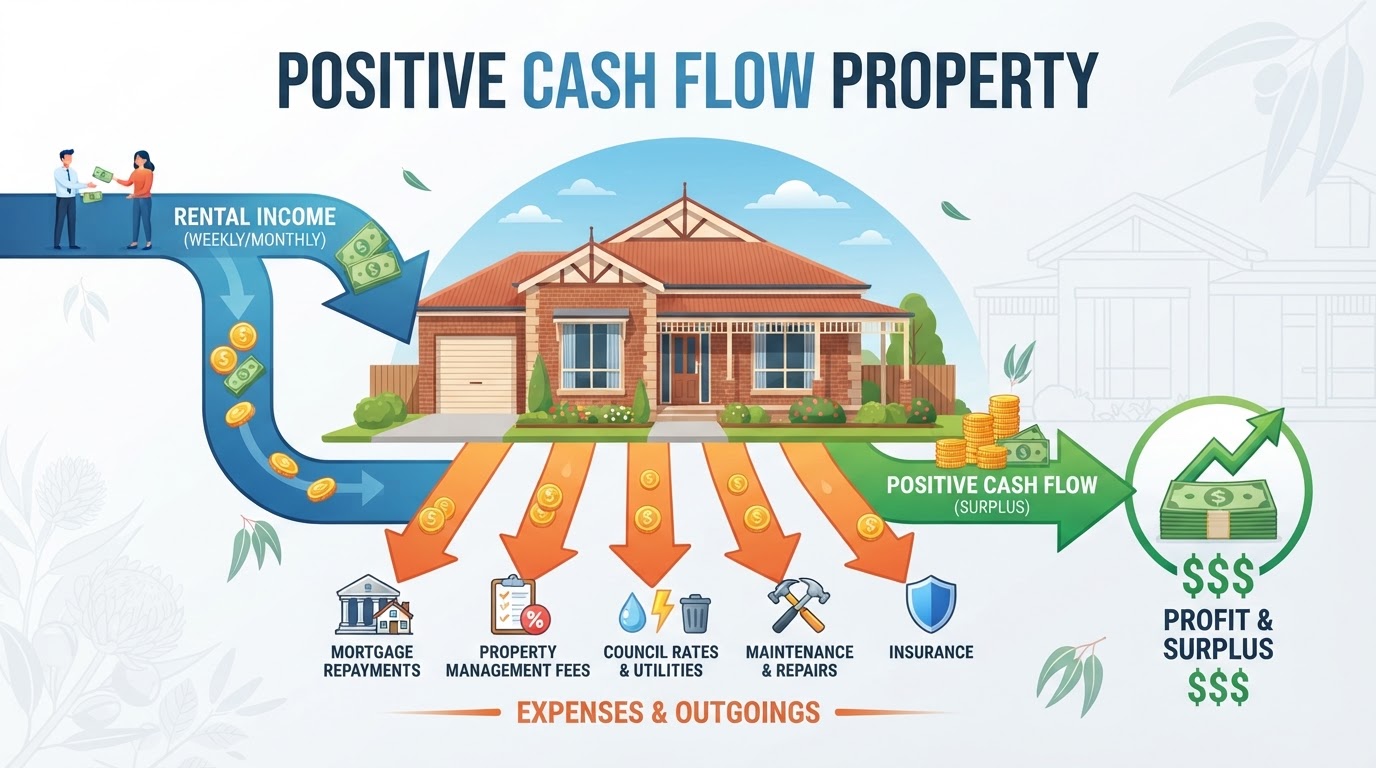
Property cash flow refers to the actual money moving into and out of owning a property over a period. Cash coming in may include rent actually received and other genuine property-related cash income where applicable. Cash going out may include property management, council rates, insurance, maintenance, repairs, strata or body corporate costs where relevant, utilities paid by the owner where relevant, finance costs where included, and other actual property-related expenses. The exact calculation depends on what is being measured, so whenever cash flow is discussed, it is important to understand which income and expenses have been included.
What Makes a Property Positive Cash Flow?
If relevant cash income is greater than relevant cash expenses during the period being measured, the cash-flow result is positive. A simple conceptual expression is: Property Cash Flow equals Cash Income Received minus Relevant Cash Expenses Paid. If the result is above zero, the cash flow is positive. If the result is below zero, the cash flow is negative. This is an educational concept only and does not imply that a positive result means the property should be purchased or that it is a suitable investment.
A Simple Hypothetical Example
To demonstrate the arithmetic, consider a hypothetical educational example only. Suppose a property receives annual rent of $26,000. Relevant cash expenses over the same period include property management of $2,600, council rates of $2,000, insurance of $1,000, maintenance of $1,400, and finance costs of $12,000 where included. Total relevant cash expenses equal $19,000. The cash-flow result is $26,000 minus $19,000, which equals $7,000 positive for the period. This hypothetical example does not represent a Barry Ison property, current market data or a recommended investment outcome. The resulting figure is not described here as good, bad, desirable, ideal or attractive — it exists only to demonstrate the concept.
Rental Income Is Not the Same as Cash Flow
Receiving rent does not mean all of that rent is available as surplus cash. Property expenses may include management, insurance, maintenance, rates, vacancy, finance costs and other ownership expenses. Rental income is money coming in. Cash flow considers what remains after the relevant cash expenses being measured. Two properties with similar advertised rents can produce very different cash-flow results because their expenses, financing and circumstances differ.
Why Vacancy Matters
Calculations based on weekly rent multiplied by 52 assume 52 weeks of rental income. Actual cash received can be different if the property is vacant, rent changes, rent is unpaid, or tenancy arrangements change. A property that appears positively cash-flowing on paper may produce a different result in practice if it is not occupied for the full period. This article does not invent vacancy rates or guarantee occupancy.
Why Property Expenses Matter
Two properties with similar gross rental income can potentially have different cash-flow results because their expenses differ. Potential factors may include management, maintenance, insurance, council rates, strata or body corporate fees, utilities, and property configuration. A property with higher expenses may produce a lower cash-flow result than a property with lower expenses even where the rents are similar. This article does not invent average costs or recommend an expense target.
How Finance Costs Can Affect Cash Flow
Finance can materially affect an investor's actual cash position. Factors may include the amount borrowed, the interest rate, the loan structure, the repayments, and individual borrower circumstances. Whether finance costs are included in a cash-flow calculation changes the result. This article does not recommend a loan structure, explain what an investor personally should borrow, recommend interest-only or principal-and-interest lending, predict interest rates, or calculate someone's borrowing capacity. Borrowing questions should be discussed with an appropriately qualified lending professional.
Positive Cash Flow vs Rental Yield
Rental yield expresses rental income relative to a stated property value or cost basis. Cash flow examines actual money received and relevant money paid out. Therefore, a rental-yield percentage does not automatically tell someone whether the property has positive cash flow. A property with a particular yield may be positively or negatively cash-flowing depending on its expenses, financing and circumstances. To understand the percentage calculation separately, see Barry's guide to how rental yield is calculated.
- Rental yield: a percentage comparing rental income with a property value or cost basis
- Cash flow: actual money received minus relevant cash expenses paid
- A high rental yield does not automatically mean positive cash flow
- Two properties with the same yield can have different cash-flow results
Positive Cash Flow vs Capital Growth
Positive cash flow and capital growth are separate concepts. Positive cash flow relates to income and expenses over a period. Capital growth describes an increase in property value over time. A property's cash-flow position does not tell the reader what its future property value will do, and positive cash flow does not imply weaker or stronger capital growth. For a deeper comparison of these measures, see Barry's guide to Capital Growth vs Rental Yield.
Is Positive Cash Flow the Same as Positive Gearing?
These terms are sometimes used loosely or interchangeably in general property discussion, but they should not automatically be treated as identical in every financial or taxation context. Taxable income and actual cash flow can differ because taxation rules may involve deductible expenses, capital expenses, depreciation or capital works, and other taxation treatment. This article does not explain what an individual reader can claim, does not provide tax calculations, and does not say whether a property is positively or negatively geared for tax purposes. Taxation issues should be discussed with an appropriately qualified tax professional who can consider your individual circumstances.
Pre-Tax and After-Tax Cash Flow
Property cash flow may be discussed before or after taxation effects. However, taxation depends on the individual taxpayer and applicable rules. This article does not provide tax estimates, tax refund calculations, depreciation benefits, or tax-saving claims. A cash-flow figure that includes taxation assumptions is a different measure from one that does not, and the two should not be compared as though they are equivalent. Keep this distinction in mind whenever you encounter a cash-flow figure.
Does Positive Cash Flow Mean the Property Is Profitable?
Not necessarily in every sense of the word. Positive cash flow describes cash movement over the measured period. It does not automatically account for or determine changes in property value, all acquisition costs, eventual selling costs, taxation outcomes, opportunity cost, or every financial factor affecting total return. A property that is positively cash-flowing over a particular period may still produce a different overall financial result once all costs, taxation and property-value changes are considered. This article does not provide accounting advice.
Does Positive Cash Flow Mean a Property Is a Good Investment?
Not necessarily. Positive cash flow describes one financial characteristic of a property. It does not determine whether the individual property is suitable. Other matters may include property price, location, tenant demand, housing supply, vacancy, property condition, management, title, planning, resale characteristics, property type, risks, and investor circumstances. A property marketed as positively cash-flowing may still carry weaker tenant demand, higher expenses, greater location-specific risk, or characteristics that do not align with an individual investor's objectives. Cash flow should not be considered in isolation.
Can Cash Flow Change Over Time?
Yes. Cash flow can change because rent may change, vacancy may change, maintenance expenses may arise, insurance can change, rates can change, finance costs can change, management costs can change, and occupancy arrangements can change. A property that is positively cash-flowing in one period may not remain so in another. This article does not predict the direction of any change.
Property Type Can Affect Cash Flow
Different property configurations can have different rental arrangements, expenses, management requirements, maintenance, utilities, and occupancy characteristics. Examples may include houses, house-and-land property, dual-key property, duplexes, and co-living. This article does not say one produces better cash flow than another. Where useful, you can explore Barry's guides to Dual-Key Property Investment, Duplex Property Investment, and Co-Living Property Investment for more detail on those configurations.
Why Location Still Matters
Cash flow cannot be considered separately from the property's local market. Potential factors include tenant demand, employment, housing supply, affordability, transport, services, competing rentals, and local demographics. A property in an area with weak tenant demand or high competing supply may face vacancy or rent pressure that affects cash flow regardless of the headline figures. For a broader look at how Barry researches Australian property locations, explore the Property Investment Locations guide. This article does not recommend a location for positive cash flow and does not create a positive-cash-flow suburb list.
Questions to Ask When Someone Promotes a Property as Positive Cash Flow
When a property is marketed as positively cash-flowing, it is worth understanding the assumptions behind the figure. Useful questions include: What rental income has been assumed? Is that rent actual or estimated? Has vacancy been allowed for? Which expenses have been included? Which expenses have been excluded? Are finance costs included? What interest rate assumptions have been used? Is the calculation before or after tax? Are any depreciation or tax assumptions involved? What time period does the calculation cover? Is the cash-flow figure historical, current or projected? Can the underlying figures be independently verified? These questions are for research only and do not form a buy or no-buy scoring system.
- What rental income has been assumed, and is it actual or estimated?
- Has vacancy been allowed for in the calculation?
- Which expenses are included, and which are excluded?
- Are finance costs included, and what interest rate is assumed?
- Is the figure before or after tax?
- Is the cash-flow figure historical, current or projected?
Projected Cash Flow Is Not a Guaranteed Outcome
A projected positive-cash-flow figure depends on assumptions. If someone assumes future rent, constant occupancy, future interest rates, or future expenses, the result is a projection, not a confirmed outcome. Projected cash flow should not be presented as guaranteed. Assumptions can change, and actual results may differ from projections. Whenever you encounter a projected cash-flow figure, ask which inputs are estimates and how sensitive the result is to changes in those inputs.
Barry Ison's Approach
Barry does not assess a property simply because it is marketed as positive cash flow, high yield, dual income, or strong rental return. Barry has more than 40 years of Australian property-industry experience. His research may also consider the investor, the individual property, location, rental demand, housing supply, expenses, property type, employment, infrastructure, risks, and broader property fundamentals. He does not guarantee positive cash flow, find guaranteed cash-flow properties, predict rental income, or guarantee investor returns. To understand how Barry researches individual property opportunities beyond a single cash-flow figure, explore his Property Investment Services. Barry also explores the importance of looking beyond a single property statistic in The Diamonds of Australian Real Estate, drawing on more than 40 years of property experience. The book provides deeper education about Australian property markets, property research, different property types, and the questions investors may investigate. Reading the book does not guarantee positive cash flow or improved investment outcomes.
Frequently Asked Questions
Common questions Australian investors ask regarding property investment strategy and market entry.
- Positive cash flow describes cash income exceeding relevant cash expenses over a measured period.
- The result depends on which income and expenses are included in the calculation.
- Rental yield and cash flow are different measures — a high yield does not automatically mean positive cash flow.
- Positive cash flow and positive gearing should not automatically be treated as identical, as taxation treatment differs.
- Cash flow can change over time as rent, vacancy, expenses and finance costs change.
- Positive cash flow does not automatically make a property a suitable investment.
Summary & Strategic Outlook
Positive cash flow describes one aspect of a property's financial position — whether relevant cash income exceeds relevant cash expenses over a measured period. It is not the same as rental yield, not the same as capital growth, and not automatically the same as positive gearing, because taxation treatment can differ from actual cash movement. The result depends on which income and expenses are included, and cash flow can change over time as rent, vacancy, expenses and finance costs change. A higher yield or multiple rental areas do not automatically mean positive cash flow, and positive cash flow does not, by itself, determine whether a property is suitable. Barry Ison's approach is to look beyond a single cash-flow label and consider the individual property, location, expenses, risks and the investor's circumstances. To understand how Barry researches individual properties, explore his Property Investment Services. General Information Disclaimer: This article is provided for general educational and informational purposes only. It does not take into account your personal objectives, financial position or needs and does not constitute financial, investment, taxation, legal, lending or property advice. Property cash flow depends on rental income, expenses, financing, vacancy and other circumstances that can change. Tax treatment also depends on individual circumstances and applicable law. Consider obtaining independent advice from appropriately qualified professionals before making financial, taxation, lending or property decisions. Historical examples and past performance are not indicative of future results.

Barry Ison
Property Investment Advisor with over 40 years of hands-on experience guiding Australian investors through property acquisition, growth corridor analysis, negative gearing strategy, and long-term portfolio structuring.
Related Market Insights
What Is Property Investing? An Educational Introduction
A clear educational introduction to what property investing means in Australia — covering how it works, capital growth versus rental income, different property types, location and risk considerations, and why a property label does not determine an investment outcome.
What Is a Dual Key Property? Understanding the Configuration
An educational guide to what a dual key property is in Australia — covering how the configuration works, the single title structure, how it differs from a duplex, potential characteristics, risks to investigate, and why the configuration does not determine investment returns.
7 Things to Compare Before Choosing Between Dual-Key and Duplex Property
A practical comparison of the seven factors worth researching when comparing dual-key and duplex investment property in Australia — configuration, title, privacy, demand, management, location and resale.
Book Your Personal Strategy Session
Speak directly with Barry Ison (40+ years experience) to discuss your financial targets and build a customized property portfolio strategy.
